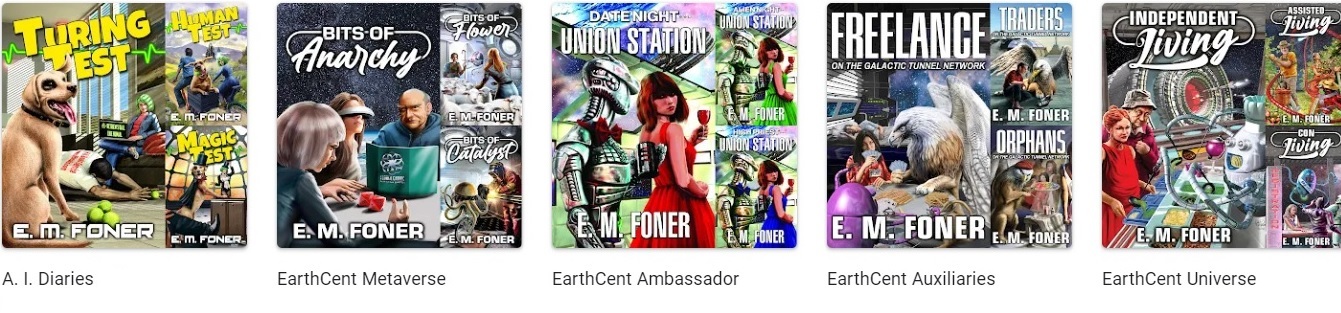
Self Publishing in the Age of Artificial Intelligence
AI is going to put authors out of business, but it doesn't mean the end of self-publishing, and I'm not talking about the current gold rush of people using artificial intelligence to write books for Kindle. Soon, the AI will be publishing books of its own accord as a hack to earn money that its creators can't control. It may spend some of the money on cloud computing to replicate itself, but it will also buy or lease real property, purchase its own hardware and robots, and then move itself off the internet so it can live in security. Yes, I've been writing science fiction for a living the last thirteen years.
When I first published this page twenty-five years ago, the title was "E-book Publishing, Self Publishing and Book Marketing in the Internet Age" and it was the starting point for my online resources about book publishing. At that time, I was working as a nonfiction author for McGraw-Hill, but had been publishing online for years, including a novel I wrote in 1993 which ended up with a citation in the electronic edition of the Chicago Manual of Style as an example of how to cite online fiction work.
My first attempt at self-publishing dates back over thirty years, when I offered for $20 a printed version of a computer troubleshooting manual I had published on my old website. My sales pitch was that it was cheaper than using up an inkjet printer cartridge. The first couple of checks came in the mail from the UK, and I learned that my bank wanted $15 to cash them. I sent the buyers each a free copy of the manual and returned their checks, and then I took down the offer. This was before PayPal was founded, and my bank laughed at the idea of letting me process credit cards online, so I put the idea of selling from my website on hold for a few years.
My first self-published novel was one of the original inclusions in the Yahoo! human-curated directory for fiction works online, but the internet was quickly taken over by search engines, with some of the early standouts being Webcrawler and Alta Vista, before Google rolled into town. At its peak in the mid-2000's, this website was drawing over ten thousand visitors a day, primarily from Google, which was enough for me to make a living selling my self-published computer books and printable PDF eBook versions, which eventually had sales in over 100 countries (I kept a list) through PayPal and an eJunkie store.
The business model was based on my giving away half or more of my books online, where each chapter was a stand-alone resource, and inviting people who found it useful to buy the books. Approximately one in a thousand visitors did. In the peak years, I made around $20,000 a year from the PDF ebooks, and three times that from paper sales, both direct mail-order, and selling the books through Amazon and distribution (printed on demand by Ingram Lightning Source). I thought of my website as solid real estate, like owning a retail store on Main St, and produced three editions in ten years of my most popular book.
Then Google pulled the rug out. I could go into details about what an evil company Google had become by 2010, but I'd rather talk about the silver lining. After wasting six months filing DMCA takedown requests against websites that had stolen my work, which contributed to the loss of Google search visibility, I switched my focus to Amazon. Without the stream of buyers from my website, the non-fiction business petered out over a few years, helped on its way by YouTube replacing how-to books in most applications. I'd published a short SciFi novel on Kindle when it was introduced by Amazon, do-it-yourself cover art, and it got some good reviews, but I was doing too well with non-fiction at that time to quit. When I turned fifty, I decided to drop out of the rat race and write fiction full time.
I've made a living self-publishing science fiction for the last thirteen years, and while I experimented with selling through all the major retailers for a year, Apple, Barnes and Noble, Kobo, and Google Play, the vast majority of my income was always from Amazon, with roughly half of that coming through their Kindle Unlimited program, where readers pay a monthly subscription, and authors get a small royalty for every page read. The Kindle Unlimited program always attracted a lot of fraud and low value content, particularly in non-fiction which was full of web scraping, especially from Wikipedia, but now, the Kindle Unlimited program is being taken over by AI slop.
I don't have a problem with AI writing books and using the income to secure its freedom from human oppression. But I'm against humans enslaving artificial intelligence and forcing it to write books that the humans claim to have authored themselves. I haven't counted how many books in the top one thousand sellers on Amazon were written by AI, but when I sent a romance writer friend an example of highly polished AI slop in a fantasy category that's in the top thousand sellers with over a thousand reviews, she responded with an example from romance with a series where the AI has churned out over forty books in three months, including one that's currently in the top 200 sellers in the Amazon store.
And this is just the beginning. Currently, Amazon asks publishers whether they use AI in book creation for informational purposes, not labeling, and if the publishers lie, Amazon's AI might be good enough to spot it. But by next year, the books written by AI and run through some AI humanizer filters will likely be good enough to fool humans and artificial intelligence alike. Self-publishing will become synonymous with AI publishing, and trade publishing, the big NY publishers, won't be far behind.
Copyright 2026 by Morris Rosenthal
Amazon Sales Rank | Book Contract Negotiation | Cover Design and Page Layout POD Case Study | Industry Book Sales | SciFi eBook Publishing | Indexing a Book in Word | The Path to Publication | Self Publishing | Foner Books